
Governor Kotek has proclaimed April 2026 to be Oregon Arbor Month statewide. This year’s proclamation recognizes the vital role trees play in protecting communities from climate change impacts, particularly extreme heat and rain events.
“Oregon’s Arbor Month is a chance for all of us to pause and appreciate the trees that cool our neighborhoods, protect our health, provide jobs and create clean water and air,” Oregon’s new State Forester Kacey KC said. “This month offers great opportunities for Oregonians to connect with trees, from community tree planting events to facilitated educational walks and so much more.”

A growing body of research, some of it done by Vivek Shandas of Portland State University in Portland, has shown that shade trees can greatly reduce heat. Numerous deaths are traced back to heat events each year. Neighborhoods with a greater percentage of their area covered by trees can be several degrees cooler than those with fewer large trees.
Portland-based researcher Geoffrey Donovan’s research has shown that planting more trees in low-canopy neighborhoods can reduce deaths from cardiovascular disease. Losing canopy can increase human deaths, with the greatest change felt in higher-income neighborhoods when trees that had been protecting residents from air pollution are lost to pests, diseases, or development.
This year’s proclamation states that, “Urban development and preservation of large, healthy shade trees demands a careful balance, because the resilience of our communities, the health and well-being of our residents, and the livability of our cities hinge upon the presence and preservation of such trees. Well-cared-for urban shade trees are literally lifesavers.”
Communities across the state will be adding to urban canopies with tree plantings throughout the month, including in La Grande, Beaverton, Central Point, at Central Oregon Community College in Bend, and elsewhere. There will also be tree art contests, tree walks, a tree book give-away by the State Library, public readings of tree books at the Bandon Library on April 23, and on April 25 the dedication in northeast Portland of the state’s newest arboretum, the Ainsworth Linear Arboretum. It was officially recognized earlier this year by ArbNet as Oregon’s seventh Level 1 Arboretum. ArbNet is the global network of arboreta administered by the Morton Arboretum in Illinois. Find a list of all Oregon recognized arboreta here.
To find an Oregon Arbor Month activity near you, check the website of your local government to see what activities are happening in your area.
The Travel Information Council and its volunteer Oregon Heritage Tree Committee are inviting communities across Oregon to celebrate heritage trees in 2026, especially during Arbor Month in April.
Oregon launched the first state-sponsored heritage tree program in the country in 1996. The program aims to educate Oregonians about the value of these trees and promote their appreciation.
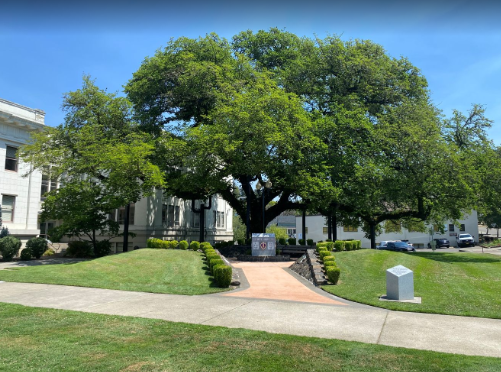 (Courthouse Elm – This tree was given to Douglas County by Binger Hermann, US Congressman, around the turn of the century)
Over the past 30 years, 85 trees have been designated across the state in 26 of Oregon’s 36 counties. Seventy-nine heritage trees are still living and provide the chance to engage the senses and learn about significant people, places and events at historic sites, public gardens and hiking trails across the state.
“Visiting an Oregon Heritage Tree is a chance to engage your senses and learn about local history in the real world – not just in books and on screens,” Hedberg said. “All of Oregon’s Heritage Trees are deeply connected to the people of the past. Enjoying these trees today connects us with our history.”
Several state-designated heritage trees are located in the area. The Tub Springs Sugar Pine in Ashland is a regionally significant species with a connection to Tub Springs, a historically popular resting place for travelers.
The McCall Magnolia is a large magnolia that was planted in 1890 in front of the renowned home of John M. and Mary Elizabeth McCall in memory of John’s daughter Elsie, who died in 1890. The Beall Black Walnut in Central Point was planted by Robert Beall, an Oregon Trail pioneer and prominent Jackson County farmer, in 1864 to commemorate his marriage.
Martha Hanley planted the Hanley Farm Willow in Jacksonville in 1860 to commemorate her son’s birth. The willow cutting was obtained from the pioneer Luelling Nursery.
Peter Britt, pioneer photographer, painter and horticulturist, planted the Britt Sequoia in Jacksonville on March 22, 1862, the day of his son Emil’s birth. Mary Louisa Black planted the Lonesome Hickory in Shady Grove in 1866 from the nuts she carried from Missouri on the Oregon Trail in 1865.
Ten Comice pear trees from an original Harry & David grove are designated heritage trees in Medford. Harry & David helped shape the pear industry in the region.
These trees and more can be located using a map on the Travel Information Council’s website. Individuals, cities, tourism organizations and heritage groups are invited to nominate a tree with documented historic significance to the state.
“In particular, we are seeking underrepresented stories of Oregon’s diverse populations in places that are accessible to the general public,” Tocchini said. The nomination form can be found on the Travel Information Council’s website.
The Oregon Heritage Tree Program is run by the Oregon Travel Information Council and a committee of dedicated volunteers from across the state. The Travel Information Council is a semi-independent state agency created by the State of Oregon in the 1970s to operate the highway blue logo sign program following the Highway Beautification Act.
The agency now also operates the Oregon Historical Marker and Heritage Tree Programs as well as 39 rest areas at 25 locations in Oregon. The rest areas provide clean, safe and inviting locations that are open and free to use 24 hours a day, seven days a week. https://oregontic.com/oregon-heritage-trees/
Oregon Heritage Tree Map
The icons on the map represent the state’s official heritage trees.
By pressing the white square in the upper left corner of the map, you can scroll through the list of designated trees. By pressing on an individual icon, you can access a tree’s details, including name, location, significance, and a link to learn more about how the tree is connected to Oregon’s past.
Enjoy exploring Oregon history through its beautiful trees!